Who We Are
Who We Are
What is Jazlab like?
I imagine there are a few things you’d like to know: 1) what our research is about and whether it aligns with your interests, 2) what your experience might be like if you join Jazlab, and 3) what you can expect after you leave Jazlab. The objective of this handbook is to give you a general sense of these areas.
Is research in Jazlab aligned with my interests?
The front page of our website is quite honest about our scientific goals, so let me start there.
If you were a cognitive neuroscientist, you might devote your research to the magic of mental computations. If you were an engineer, you might want to reverse-engineer the brain’s algorithms. If you were a physicist, you might see the brain as a system of recurrent neural networks generating complex neural dynamics.
Jazlab is a team of explorers at MIT working toward a mathematical framework that connects these different levels of description. We want to understand how dynamic patterns of neural activity in the brain—as well as in artificial neural systems—give rise to algorithms that support mental computations.
To tackle this problem, we work with humans, macaque monkeys, and models. Our work with humans focuses on behavior and on developing normative theories of mental computation. We also use human behavior to guide the design of experiments for animal models. In monkeys, we record and perturb brain signals while animals perform tasks involving different mental computations.
We then combine behavioral and neural data with normative theories, computational models, and neural networks to understand the building blocks of the mind in terms of the mechanisms and algorithms implemented by the brain.
The lab is best suited for people whose primary questions concern the brain mechanisms that support behavior and/or mental computations. Here are some examples:
- What is the secret behind our apparently limitless memory capacity? Why do some memories seem crisper than others?
- How do we build internal models of our environment? How do we build internal models of other people? How do we use such models to make predictions? How do we know when something doesn’t make sense?
- How is it that we have such a vivid sense of everything around us, including things we cannot directly see?
- What is an object? What is an event? How do we represent such broad categories in our minds?
- How can we sometimes learn so quickly—from just a glance or an instruction? How do we flexibly apply old knowledge to new situations, or compose new knowledge from things we already know?
- How do we learn statistical regularities, associations, and causal relationships in our environment?
If you are interested in these kinds of questions, have ideas about how to tackle them, and ultimately want to understand the underlying neurobiology—that is, to study actual brains, rather than only neural networks or other computer models—then your interests are well aligned with research in the lab.
Generally, our research is not centered on neurotechnology, engineering applications, disease models, or treatments. We certainly rely on neurotechnology; we make use of machine learning and AI tools; and we care about biology across multiple scales, from genes and dendrites to cells and circuits. But we consider these within the broader context of behavior and mind rather than as the primary targets of our research.
Is the Jazlab environment good for me? What can I expect, and what is expected of me?
Everyone’s experience in Jazlab is tied to a set of agreed-upon—and annually revisited—commitments that we make to our science and to one another. I divide these into two broad categories: 1) commitments to each other, and 2) commitments to science.
Commitments to each other
We are a close group in Jazlab, both scientifically—despite many healthy discussions and debates—and socially. We discuss science collectively; people talk frequently with one another about their work, and nearly everyone knows and cares about the projects happening across the lab. We also organize lab outings and gatherings throughout the year.
We do multi-day ski trips, full-day parties at my home, smaller social gatherings in parks or over picnics, multi-day cultural events such as the Newport Jazz Festival, and celebrations of personal events such as birthdays and professional accomplishments such as paper publications. I love the social character of the lab because I think it contributes both to our science and to the spirit of the lab as a whole, and I hope to preserve it.
I therefore expect you to make a serious effort to get to know the people and the culture of the lab. Being an engaged member of our intellectual community is important, but participation in social activities is always optional. People differ in how they socialize and in their circumstances and commitments outside the lab, and I want people with different personalities and lives to feel equally at home here.
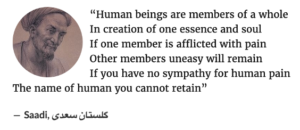
If you decide that Jazlab is your kind of group, then you have our commitment. We will care for you personally and professionally, and we hope that you will bring the same spirit of care and generosity toward others in the lab. Inspired by the following poem from Saadi, I think of us as parts of the same body. We collaborate and help one another because we can move only if we move together.
As the head of the lab, I have many responsibilities and commitments to you. I want to share some of them so that you know what to expect.
I am very involved in the research activities in my lab. I meet with everyone at least every other week, and more frequently when needed—you help determine that frequency. I provide feedback and guidance at many levels. I love discussing big ideas: which questions are exciting and interesting, and why.
I help make sure your project can be integrated with the intellectual powerhouse of the lab. I expect you to think hard about hypotheses and predictions and to discuss these questions extensively so that you gain clarity about what you are trying to understand.
I help you identify the relevant literature you need to know for your project. I am involved in project design down to small details, with the goal of finding the simplest experiment capable of addressing your problem of interest.
I value simplicity and try to make sure we do not make problems more complicated than they need to be. I help you acquire the technical knowledge you need to succeed. Depending on your project, that might include developing an appropriate curriculum for animal training, acquiring the hands-on skills needed for neurophysiology experiments, developing sophisticated analysis techniques, building models of behavioral and neural data, framing the central question for a manuscript, or preparing and writing grants, fellowships, and papers.
Across all of these areas, one thing people in the lab appreciate is that I am always there, and viewed as being extremely responsive.
Finally, I am responsible for making sure that you have the resources—financial and otherwise—that you need to succeed.
In return, I have expectations of you.
If you are a graduate student or postdoc, I expect you to bring your own ideas and to be in the driver’s seat of your project. If you prefer a lab in which the PI gives you a project and tells you what to do, then my lab is probably not a good home for you.
I expect you to take ownership of your learning, to become a scholar, and to read the literature broadly and deeply. I expect you to follow through on the actions we agree upon.
I expect you to take the time to prepare for our meetings, usually with an easy-to-follow presentation that helps me understand where things stand and what we need to think about. I am thinking about many projects—not just yours—and I need your help if I am to give you the best advice I can.
I expect you to keep me abreast of your project frequently and transparently—all roadblocks, successes, and new plans—because I can only help with problems and opportunities that I know about.
I expect you to feel comfortable stepping into my office to ask questions, and I expect urgent questions to be asked urgently rather than sitting on them.
I also expect you to be honest and transparent about your time management and about difficulties that are affecting the progress of your work.
Basically, when it comes to our science, I hope you will see me as an excited collaborator. When it comes to resources and the practical conditions that enable you to do your work, I hope you will see me as a caring boss who needs to hear clearly about what you need so that I can help your research proceed smoothly.
I am passionate about what we do, and I discuss science impassionately. Some people really like this characteristic of mine; others find it overwhelming. I can’t help being passionate, so you need to decide for yourself whether this is something you enjoy.
I am also honest and transparent and try to avoid unnecessary diplomacy. This matters to you in two ways.
First, you can be sure that I have no hidden agenda. You can always step into my office and ask about something you are uncertain about, and I will give you an honest answer.
Second, you can expect honest feedback. I may not volunteer critical feedback about you personally unless I think it is important or you have asked for it, although I will always give candid feedback when it is essential for the science we do. I am also happy to give broader feedback about your strengths, weaknesses, and areas for improvement whenever you ask.
I believe critical feedback should be candid, specific, useful, and delivered in a way that helps you grow.
In return, I appreciate honest and critical feedback from you, and I accept it gracefully. I also want you to tell me when my feedback—or the way I deliver it—is not helpful.
Commitments to science
Relatively speaking, doing research in Jazlab is not “easy.”
We aspire to tackle big problems, and we recognize that they are hard. We succeed at what we do because of a few important characteristics.
First, we are seriously committed. We put in the time and effort required at every stage—from the early exploration and inception of ideas, through repeated iterations and working out the kinks, to conducting research at the highest standard, completing what we start, and reporting our findings honestly.
There will be challenges and frustrations along the way. We accept that and work through them together because we are curious and passionate about what we do, and because we recognize that nature doesn’t reveal its secrets easily.
If you are committed in that way, then you will find a welcoming home in Jazlab.
Second, we promote a healthy work-life balance and actively create opportunities for fun, both within and outside the lab, to support well-being, avoid burnout, and make sure we remain motivated.
We are demanding about the quality, rigor, and seriousness of our work—not about performative hours or sacrificing the rest of your life. Difficult science requires sustained effort, but exhaustion is not evidence of commitment.
In some sense, we see our commitment to science as deeply intertwined with having a healthy and sustainable life. That makes our science better as well as improving our well-being.
As a result, you can expect me to respect your need for time off and your life outside the lab. If your workload or circumstances are becoming unsustainable, I hope you will feel comfortable telling me what changes or support from me would be helpful. You should never feel obligated to disclose private health information.
Third, we collaborate.
Projects in my lab are highly multifaceted.
A single project might involve designing a novel task; collecting data from human participants; building latent models to test computational hypotheses; devising a version of the task for monkeys; spending many months on animal training; acquiring and using specialized skills to record from or perturb neural responses in awake, behaving animals; developing neural-network models to generate or test hypotheses; using dynamical-systems analyses to understand the principles by which neural activity computes behaviorally relevant variables; and ultimately putting all of these pieces together to generate a comprehensive understanding that connects mental computations to brain mechanisms.
The satisfaction we get from tackling problems so deeply and comprehensively is hard to describe. It is exhilarating when you figure the whole thing out.
But all of that is far too much work for one individual. We collaborate because it is necessary, and because it is fun.
We have many ongoing collaborations and value them enormously. Everyone who joins Jazlab should therefore expect collaboration to be a central part of their scientific life.
We think together, learn together, do things together, and share the joy of discovery together. In some sense, we enhance the experience by sharing it.
Fourth, almost everyone works on multiple projects with different degrees of complexity.
I help everyone think through project selection when needed. I try to make sure that some projects are relatively straightforward, so that you can continue to feel progress when a more complex project inevitably slows down.
Working on multiple projects also contributes directly to our collaborative culture: it creates many arrows connecting different people working on different topics.
As a result, you can expect to be involved in multiple exciting projects. And you are expected to treat collaborations genuinely, to work effectively with others, and to handle misunderstandings and disagreements with thoughtfulness and grace.
Fifth, we teach each other.
We do this deliberately because it increases collaboration and makes the environment more enabling for everyone.
For example, new students may be paired with a more seasoned researcher who can help them get started with their research. Both people benefit. The learner gets to learn without having to navigate every uncertainty alone when starting a new project. The teacher gains a collaborator who can eventually contribute to data collection, analysis, and other aspects of the work. Over time, the learner becomes the teacher, and the cycle continues.
All of this makes our science better and, as a dividend, increases everyone’s productivity.
A second example is teaching one another to code. We have an active weekly code-review session in which people share best practices, introduce new tools that others may not know about, and point people toward pieces of existing code that can readily be reused.
Code review strengthens our scientific rigor, reduces the chance of errors, helps us create code that is more readable and useful both inside and outside the lab, and makes everyone a better coder.
A third example is our informal “pizza nights,” when we get together to discuss something interesting and learn from someone about a topic that might be relevant to our research but that most of us do not yet know enough about.
Past pizza-night topics have included topological analysis of neural data, philosophy of mind versus neuroscience, and the mathematics of manifolds.
These activities enable our science to reach farther and help each of us expand the basin of our knowledge.
Sixth, we recognize the privilege of working at the bleeding edge of science at one of the most enabling institutions in the world. We also understand the responsibility that comes with that privilege.
That responsibility has many dimensions. I’ll highlight a few.
First, we must uphold the highest standards of research ethics because relatively few people in the world have the opportunity and resources that we have to advance human knowledge.
Second, we must conduct our work with extreme rigor and report our results honestly, both because we want to be a model for others and because we want to minimize the chance of misleading ourselves or anyone else.
Third, we must share. This means adhering to the most progressive forms of open science and scientific sharing that we can. We aspire to lead in this space rather than follow, and we expect everyone in the lab to commit to that aspiration.
Learning from examples
If you are new to the lab, we have something valuable that can help you understand what your own trajectory here might look like.
We have assembled a repository describing the research trajectories of past and current members. It covers general topics such as the pace of research, approximate timelines for different stages of a project, milestones worth keeping in mind, and more. You can ask the lab manager or me for the link to this repository.
The main purpose of the repository is to help you envision and plan your own trajectory through the lab.
The documents contain summary information about each member’s background, interests, timelines, and related topics. They also contain information about opportunities such as conferences and fellowships, as well as topics on which particular members of the lab can provide especially useful advice.
When you first join the lab, I recommend reading through these documents. They are also useful when you schedule your first one-on-one meetings with other lab members.
Once you are well adjusted to the lab, we want you to pay it forward by creating your own trajectory document and updating it at least once a year.
Beyond serving as a guide for people who come after you, I hope it will also give you an opportunity to review your progress, assess where you are, and think deliberately about where you want to go next.
What is my outlook after my tenure in Jazlab?
Rest assured that my support does not end when you leave.
If I can help you at subsequent stages of your career, just ask. I will always be eager to help.
I fully support both academic and non-academic career paths for people in the lab, as well as academic careers that emphasize teaching more than research.
If your goal is to go to graduate school, I will be happy to give you honest feedback about where you stand and to write a recommendation letter that highlights the best in you.
If you are a graduating PhD student, I will be happy to serve as a sounding board as you think about your next move, to offer thoughtful advice, and to support you to the best of my ability regardless of where you decide to go.
I know the most about academic career paths, but I also have contacts in industry and am happy to make introductions when they would be helpful.
I want to stress that I will not be disappointed if you become interested in a path that deviates from the academic research trajectory. Don’t be shy about bringing it up. I can tell you about my own trajectory to MIT, so you know how deeply I respect people finding and following their own paths.
For those of you who aspire to become faculty members immediately after leaving Jazlab, I will do what I can to help you succeed.
I will be happy to discuss ideas that you may want to pursue in your own lab. I will help you prepare a top-notch faculty application and will be happy to work with you on both your job talk and chalk talk.
You are free to choose whatever research topics you wish to pursue after leaving Jazlab. Jazlab places no restrictions on the science you choose to do.
If you are concerned about possible overlap with ongoing or upcoming research in Jazlab, don’t hesitate to discuss your ideas with me.
And, resources permitting, I will try to support you if you want to begin exploring some of your own ideas before you leave.